Trivia Game Rules: The Complete Guide
Question: How do you learn to run a team trivia competition? Answer: By reading this article!
You don’t need a group to enjoy trivia – you can always quiz yourself on any number of topics online. However, most people would agree that a team trivia competition is more fun and exciting than spending another 30 minutes on the internet. And the best part is, you don’t need to go down to the local bar for trivia night or dust off that old box of Trivial Pursuit.
Running your own team trivia competition simply requires some friends, some questions, and a few easily obtained props. Oh, and the rules – you know, the subject of this article. While there are many possible ways to run a do-it-yourself trivia competition, I’ve put together some basic rules to get you started, with a printable you can use to help your game go smoothly.
Trivia at a Glance
Type: Trivia
Time: 30 minutes plus
Players: 4+
Ages: 10 and up
What You Need
Trivia Game Rules
There’s no standard way to run a trivia competition. However, the following rules offer a nice combination of simplicity and strategy.
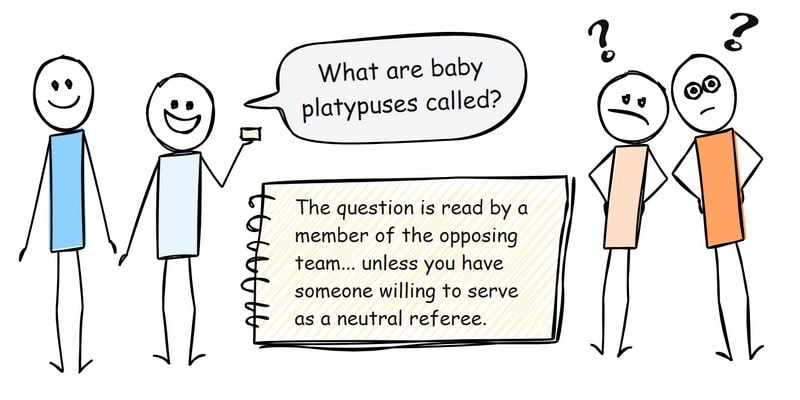
Note: One thing you will need to decide right off the bat is whether your trivia competition will have a neutral referee reading the questions. No referee? No problem – that just means someone from the opposing team reads the questions.
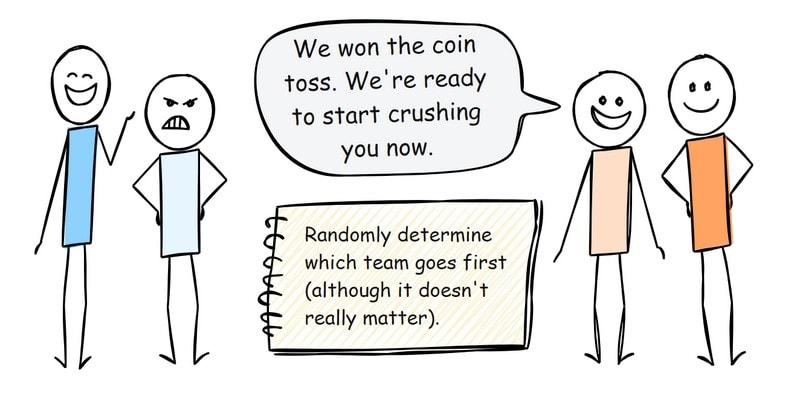
1. Divide into two equal teams and randomly determine which team goes first.
There is no advantage to going first in this game, but it’s best to flip a coin anyway.
2. The Reader draws a question and reads it to the team whose turn it is. They have 30 seconds to answer, and score a point if they get it right.
Players get only one chance to answer the question. They should put their heads together and discuss what their answer will be (ideally in private so they help the opposing team if they get a chance to steal).
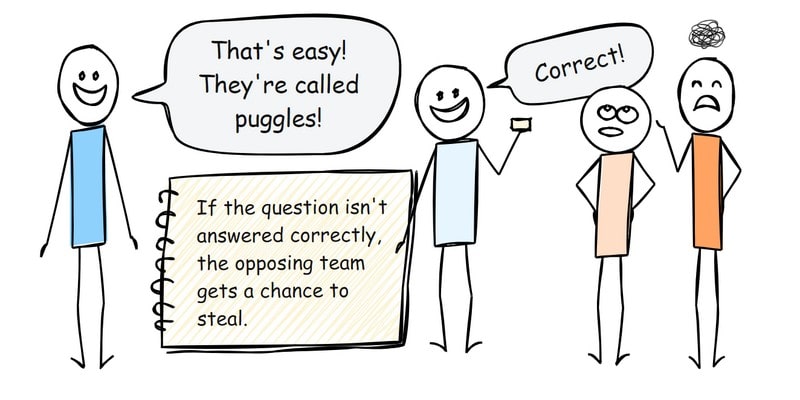
3. If the team fails to answer the question correctly, the other team gets a chance to “steal.”
The opposing team gets 30 seconds to answer the question, and if they are successful, they get the point. This is obvious, but if the Reader is a member of opposing team and can see the answer, they are not allowed to confer with their teammates.
4. Continue in like fashion, with each team taking turns, for however many rounds you like (or until you run out of questions).
If you’re not using a neutral referee, teams should alternate who serves as the Reader.
5. The team with the most points wins.
You can avoid a tie by reserving a few questions for “overtime.” In this case, continue the “rounds” (one turn for each team) until a round ends with one team having more points than the other.
Here’s a copy of the above rules in printable format. Download and print them out for your next game night.

Variations
There are endless ways you can run a trivia competition. Here are some of the best options to consider.
Variable points. The idea is simple: Make the questions worth a different number of points based on their difficulty. Easy questions are worth one point, Medium questions are two points, and Hard questions are three points. This is how trivia questions are organized on this site (although if you don’t want to follow these rules, you can simply ignore the difficulty and make them all worth one point).
Different categories. If you have questions from different categories, each team can select the category they want for their turn. This requires more setup, but pays off by giving teams more options and showcasing their unique strengths. That said, teams should not be allowed to pick the same category two turns in a row.
Educational questions. The word “trivia” implies that the subject matter is trifling. But the truth is, the questions can be about anything, including important events in History, concepts from Social Studies, and so forth. If you’re a teacher who has students who thrive on competition, a trivia contest could be an effective way to get them to learn more.
Questions
Here are some trivia questions you can use for your game. Each of these articles contains one or more printables that are compatible with the above game rules.