Charades: The Complete Guide
Welcome to Charades, the classic party game that’s all about mime over matter.
Board game companies are constantly trying to come up with the next big thing. However, there’s one legendary party game that continues to entertain people year after year, and it doesn’t cost a thing to play. In case you missed the title of this article, I’m talking about Charades.
Even if you’ve never played Charades, you probably have an idea of how it works. It’s a game of pantomimes in which players act out a word or phrase while their teammates attempt to guess the answer. There have been many spinoffs over the years, but the original game continues to shine due to its simplicity, familiarity and pure fun factor.
While there are countless ways to play Charades, this guide focuses on rules that are easy and practical, while mentioning some of the more popular variations. It also includes helpful printables for running your own game.
Charades at a Glance
Type: Team Guessing Game
Time: 1+ Hours
Players: 4+
Ages: 8 and up
What You Need
The Rules of Charades
As mentioned, there’s more than one way to play Charades. In fact, some diehard Charades fans may argue that the following rules are not the “standard” way to play. However, in my view, these are the best and most straightforward Charades rules for modern players.
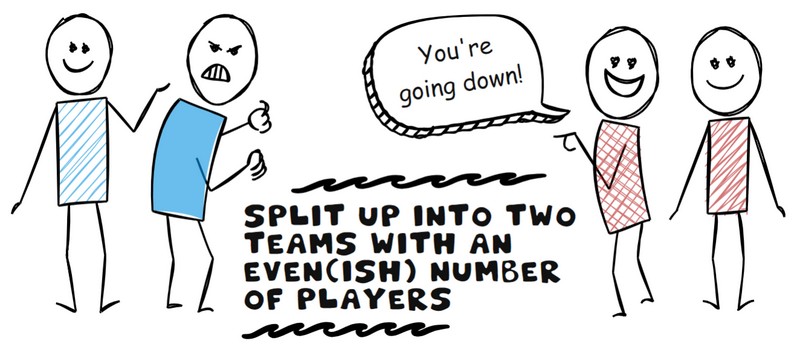
1. Divide players into two (or more) teams.
Ideally, the teams should be of equal size. However, for a casual game or one where you have children who want to participate, it’s totally fine to have uneven teams.
2. Determine which team goes first.
Flip a coin, draw straws, roll dice… whatever is convenient for you.
3. Teams decide who will act first. That person gets a Charades word or phrase and acts it out. All other players on that player’s team have one minute to guess the answer.
No speaking, mouthing words, or noises of any kind are allowed. However, players can take advantage of traditional Charades gestures (see below).

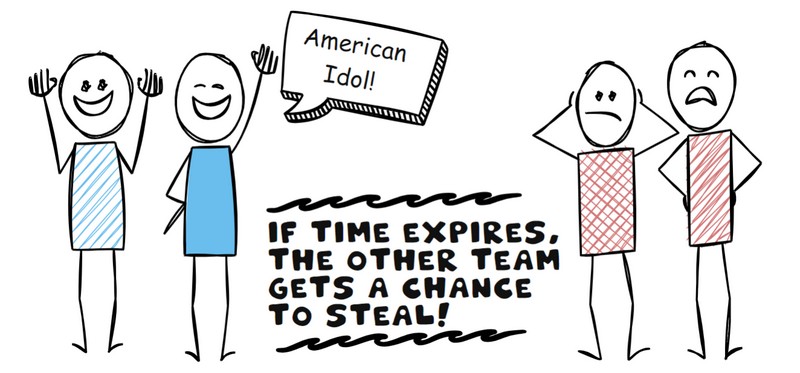
4. If the team whose turn it is guesses right, they score a point. Otherwise, the team with the next turn gets a chance to “steal.” They get one guess and score a point if they guess correctly.
If the next team guesses incorrectly, the turn is over. If playing with three or more teams, it’s not recommended to allow more than one team to steal because it could lead to a lopsided game!
5. The game continues in similar fashion, with teams taking turns and alternating actors.
Everyone should have a chance to act.
6. After a set number of turns, the game ends and the team with the most points wins.
Be sure to have extra Charades words on hand in case the game goes into overtime. Optionally, teams may be required to win by two points.
Here’s a copy of the above rules you can print out for game night:

Variations
While the above rules are optimal for many situations, there are a lot of other ways you can play Charades. Here are some of the most popular:
Timer-Based Scoring. In this version, teams get up to three minutes per turn and there is no stealing. The amount of time it takes to get the right answer is recorded and these times are added up at the end, with the team with the lowest number being the winner. For some, this is the standard way to play Charades – however, it does make scorekeeping more onerous and the competition perhaps a little less interesting.
Cooperative Charades. There are no teams. Instead, players take turns being the actor with everyone else attempting to guess the phrase. When someone guesses correctly, they and the actor get a point. After a certain number of rounds (make sure everyone gets a chance to act), the game ends and the player with the most points wins.
Competitive Prompts. Rather than use preprepared prompts, one spicy twist is to have each team come up with the phrases that the other team has to guess. Expect much more difficult phrases in this version, as each team has an obvious incentive to make things hard for the other side.
Pictionary. Pictionary is simply a variation of Charades where players draw the prompt rather than acting it out. You can generally use the same words and phrases for both games, although some prompts may be more interesting or challenging in one version or the other.
Charades Gestures
Over the years, a handful of gestures have become so well-known in Charades that they’re essentially part of the game. These gestures are optional. However, to prevent more experienced players from having an advantage, you may want to review them with the players before the game begins.
Basic
You Got it on the Nose: Point to the person who has guessed something correctly while touching the tip of your nose with your index finger.
Number of Words: Hold up the number of fingers corresponding to the number of words in the answer.
First Word (Second Word, etc.): After the number of words is established, hold up the number of fingers corresponding to the word you are about to act out.
Sounds Like: Cup your hand around your ear like you’re trying to hear something.
Advanced
Movie Title: Pretend you’re operating an old-fashioned movie camera by holding one hand up while the other cranks in circles.
Book Title: Pretend you’re opening a book by folding your hands out, palms up.
Quote or Saying: Use your index and middle fingers to make air quotes.
TV Show: Use your index fingers to draw a box in the air symbolizing a television set.
Number of Syllables: Place a number of fingers on your forearm.
First Syllable (Second Syllable, etc.): After the number of syllables is established, place a number of fingers corresponding to the syllable you’re acting out on your forearm.
Word Lists
Here are some word lists you can use for your own game of Charades. Each of these articles includes a printable – just cut out the phrases and toss them into a hat!